- Tel:+8616638907067
- Email:[email protected]
An induction furnace IGBT module failure does not have one universal outcome. In a properly designed power supply, protection may stop the inverter before one abnormal event damages multiple components. In other cases, the furnace must remain off until the failed part and its root cause are identified. Whether a system can isolate a fault excerpt …
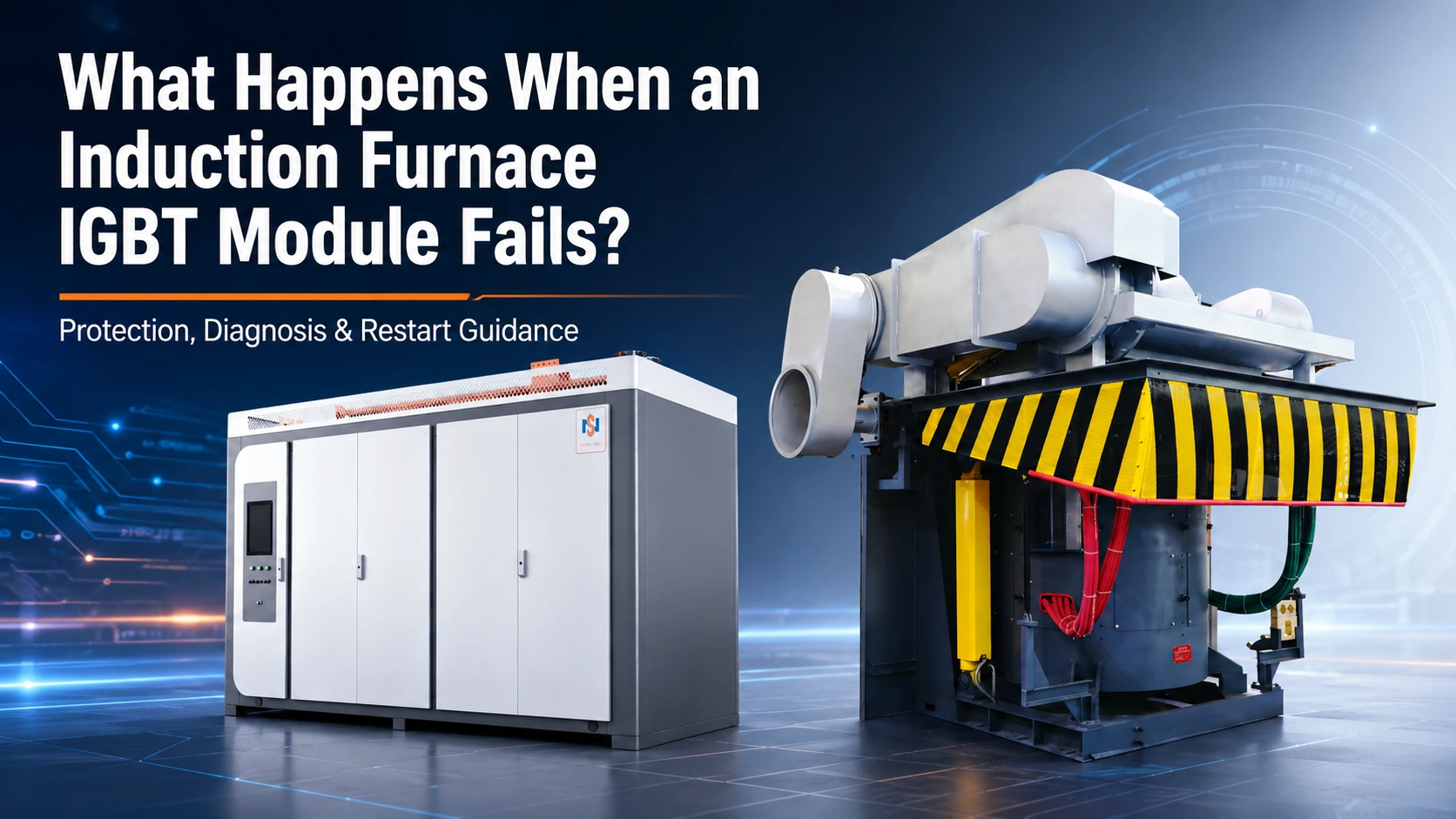
An induction furnace IGBT module failure does not have one universal outcome. In a properly designed power supply, protection may stop the inverter before one abnormal event damages multiple components. In other cases, the furnace must remain off until the failed part and its root cause are identified. Whether a system can isolate a fault or operate at reduced power depends on its exact topology, module arrangement, protection logic, cooling condition, and supplier-approved procedure.
For a foundry, the important question is not simply, “Is the cabinet modular?” It is: “What will happen to production, what must be checked before restart, and what parts and support are available when a module fails?”
A module-related alarm can result from several different events. The IGBT module itself may be damaged, but the initiating cause may instead be a gate-driver issue, cooling-water problem, blown fast fuse, short circuit, abnormal furnace discharge, sensor fault, DC-bus abnormality, or load-matching problem.
That distinction matters because replacing a power module without finding the initiating condition can lead to another failure after restart. A cabinet that trips on overcurrent may have prevented damage. A cabinet with a damaged module, burned busbar connection, or continuing cooling problem requires a more extensive inspection.
The furnace process also affects the response. If a fault occurs during cold-charge startup, a controlled shutdown is usually easier to manage than a failure during active melting or holding. When molten metal is already at temperature, the maintenance team must consider furnace lining condition, cooling continuity, metal handling, and safe holding time before deciding whether equipment can be restarted.
“Modular” should describe more than the physical ability to remove one component. It should mean that the electrical design, gate-drive control, sensing, protection, cooling, and service access help the operator identify the affected section and prevent a local fault from becoming wider damage.
In a shared-drive arrangement, one control-related problem can be harder to localize. Independently controlled drive modules can give a technician a more defined area to inspect: the relevant power module, drive board, fiber-optic trigger path, current or voltage feedback, cooling circuit, and associated connections.
SHENNAI documentation describes an IGBT module power-supply design using independently controlled drive boards. For a buyer, this feature is valuable when it is backed by usable fault information and a practical replacement procedure. Ask the supplier whether the control system can distinguish between a module, driver, cooling, sensor, or communication fault. Also ask which alarms are stored and what data can be reviewed after a protection trip.
Independent control does not prove that the affected module can always be bypassed. It improves fault localization; the actual response still depends on the installed circuit and approved operating limits.
IGBT devices can be damaged quickly by overcurrent, short circuits, excessive junction temperature, overvoltage, or incorrect gate-drive conditions. Furnace arcing and abnormal discharge can add severe electrical stress. Protection must therefore coordinate the controller, gate signals, fast fuses, sensing, DC link, and cooling interlocks.
SHENNAI describes rapid protection for short-circuit and abnormal-discharge conditions in applicable IGBT power-supply configurations. The practical benefit is risk containment: a protection event should reduce the chance that one abnormal condition develops into multiple damaged devices or connected components.
That is different from a guarantee of no damage. After a significant protection event, the team should inspect the cause, not simply reset the alarm. Repeated trips are evidence that the underlying electrical, cooling, load, or furnace condition has not been resolved.
Reduced-power operation is possible only in some architectures and only after a supplier-approved technical assessment. It is not a universal benefit of modular IGBT power supplies.
A system may need enough remaining module capacity, an approved isolation path, stable DC-bus and resonant conditions, adequate cooling, and a verified control strategy. The furnace must also be in a process condition that can safely accept lower power. A metal charge that requires rapid melting, for example, may not tolerate a long low-power cycle. A holding process may have different requirements.
The following table should be treated as a procurement decision tool, not a universal operating rule.
| Fault condition | Initial response | Can reduced-power operation be assumed? | What the buyer should request |
|---|---|---|---|
| Protection trip with no confirmed component damage | Stop, review alarms and operating conditions | No | Fault record, restart criteria, inspection list |
| Confirmed IGBT module damage | Isolate and inspect affected circuit | No | Approved module replacement and system-test procedure |
| Gate-driver or fiber-optic control fault | Stop and diagnose control path | No | Driver-board diagnostics and spare-part list |
| Short circuit or arcing discharge | Stop, inspect source of abnormal event | No | Protection sequence and post-event inspection scope |
| Cooling-water loss or overheating | Stop and restore cooling | No | Cooling interlock logic, flow and temperature requirements |
| Supplier-approved derated configuration | Follow written limits only | Possibly, depending on configuration | Module count, permitted fault cases, power limit, restart approval process |
A credible supplier should state this in writing for the offered power range and module configuration. If the proposal only says “modular design” or “easy maintenance,” the buyer has not yet received enough information to evaluate downtime risk.
A failed IGBT module is often the visible result of another problem. Before installing a replacement, the maintenance team should review the event in a structured sequence.
Start with the protection history: what alarm occurred first, at what power level, during which furnace operation, and under what cooling condition? Then inspect fuses, driver status, current and voltage feedback, water flow, heat sinks, capacitor connections, coil and cable condition, busbars, and visible signs of arcing or overheating.
Furnace conditions also matter. A lining defect, metal penetration risk, water-related issue, unstable charge, or abnormal discharge can create electrical stress that appears at the power cabinet. Restarting with a new module while the furnace-side cause remains can create another trip or cause further damage.
SHENNAI’s internal manufacturing and inspection requirements include treated copper-busbar contact surfaces, torque-controlled and marked fasteners, protected fiber-optic control routing, and water-circuit pressure testing. These are SHENNAI internal requirements, not universal industry rules. Their relevance is practical: a supplier should be able to show how connections, cooling paths, control wiring, and inspection records support reliable maintenance.
A safe restart should be a controlled engineering action, not an alarm reset. The exact procedure must follow the supplier’s drawings, electrical safety rules, and the selected cabinet configuration, but the following checks should normally be addressed:
Confirm the correct module and driver-board part numbers.
Inspect the reason for fuse operation or protection action.
Verify power-module mounting, approved fastening procedure, and thermal-interface installation.
Check copper-busbar contact surfaces and signs of overheating or looseness.
Confirm fiber-optic and control connections are secure and protected from heat exposure.
Verify cooling-water flow, temperature, pressure, leakage status, and interlocks.
Review coil, capacitor, cable, grounding, and furnace-lining conditions.
Start under the supplier-approved commissioning sequence and observe alarms, current, voltage, and cooling behavior.
For overseas plants, documentation matters as much as spare parts. A useful package includes electrical drawings, module layout, alarm-code guidance, parts list, photographs of the cabinet arrangement, and a defined method for supplying fault information to the equipment provider.
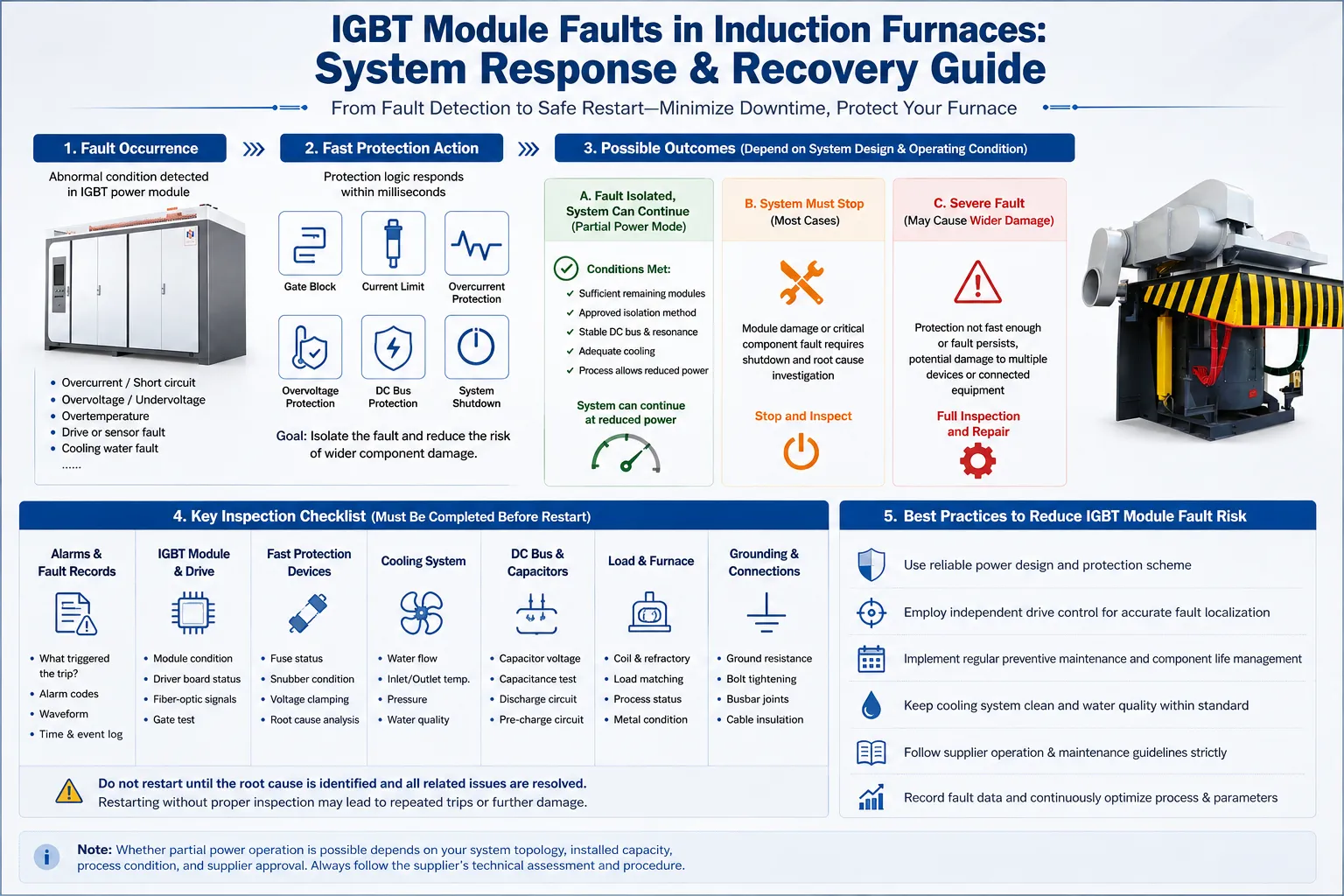
Do not ask only for cabinet power, furnace capacity, and price. A reliability-focused RFQ should require a written response to the questions below.
What does the system do after a module fault, driver fault, fuse operation, cooling alarm, short circuit, or abnormal discharge?
Can the control system identify the affected module or driver channel?
Which faults require a complete shutdown, and which conditions require inspection before restart?
Does the quoted configuration have any supplier-approved reduced-power operating mode? If so, under what exact conditions?
Which IGBT modules, driver boards, fuses, sensors, fiber-optic parts, and thermal materials should be held on site?
What drawings, fault records, commissioning steps, and replacement instructions are included?
What site information is needed for support: alarm photos, nameplate data, module configuration, cooling data, and electrical drawings?
This level of detail makes quotations comparable. It also prevents a buyer from discovering after delivery that a “modular” cabinet still depends on a long lead time for one critical part.
For projects comparing technology routes, review SCR vs IGBT reliability and service comparison alongside the complete induction furnace power-supply selection guide. A technology label alone does not determine reliability; the installed system design and support scope do.
SHENNAI’s full-bridge IGBT power-supply documentation is relevant where a foundry needs independently controlled drive modules, rapid protection against short-circuit or abnormal-discharge events, and a more structured approach to module-level diagnosis and maintenance.
The correct evaluation method is configuration-specific. Buyers should request the proposed module count, drive arrangement, protection functions, cooling requirements, fault-display method, spare-parts package, and replacement procedure for the exact full-bridge IGBT induction melting power supply being quoted.
This approach is more useful than a broad promise of uninterrupted production. It gives the plant a realistic basis for balancing capital cost, spare-parts inventory, maintenance capability, and the value of avoided downtime.
A failed IGBT module may trigger a protective shutdown, require a localized repair, or, in limited supplier-approved configurations, permit a defined reduced-power response. The outcome cannot be assumed from the word “modular.”
Before purchasing or replacing an induction furnace power supply, ask for a fault-response matrix, module and driver configuration, spare-parts recommendation, restart procedure, and any verified conditions for reduced-power operation.
For a project-specific review, submit an IGBT power-supply service and spares RFQ with the metal type, furnace capacity, rated power, input voltage, transformer data, cooling conditions, current fault records, cabinet nameplate, and clear photographs of the relevant components.
Not automatically. Continued reduced-power operation depends on the specific topology, remaining module capacity, fault type, protection design, cooling condition, and supplier-approved procedure.
A protection event may stop the inverter to prevent wider damage. Whether the furnace can restart after inspection depends on the cause of the event and the condition of the complete power and furnace system.
It may be possible when qualified personnel have the correct replacement part, drawings, tools, safety procedure, and root-cause diagnosis. The failed module should not be replaced without checking cooling, connections, drivers, fuses, and furnace-side conditions.
The package should be configuration-specific. It may include matched IGBT modules, driver boards, fast fuses, sensors, fiber-optic control parts, thermal-interface materials, and documentation for replacement and restart.

In the forging workshop, industrial furnaces smelt metals, including cupola, induction furnace, resistance furnace, electric arc furnace, vacuum furnace, open hearth furnace, crucible furnace, etc; There are sand mold drying furnace for baking sand mold, ferroalloy drying furnace and casting annealing furnace, etc; In the forging workshop, there are various heating furnaces for heating ingots or billets before forging and heat treatment furnaces for relieving stress after forging;
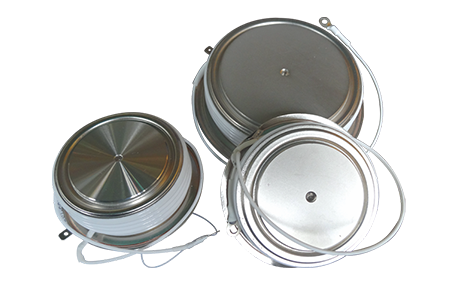
The most effective way for the failure of the medium frequency furnace is to use the low current experiment to judge whether it is the fault of the rectifier circuit or the fault of the inverter part. In the low current experiment, when the DC voltage is less than 513v, it indicates that there is a phase loss fault in the DC rectifier part. Check the specific thyristor fault, and the pulse breaking method should be used to judge whether it is the thyristor fault or there is no trigger pulse.
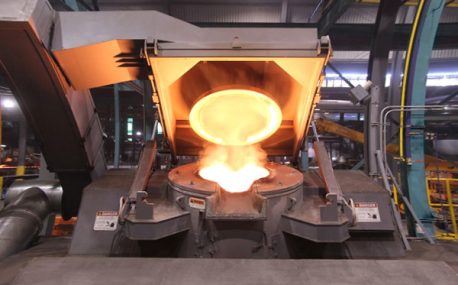
The most effective method for the failure of the intermediate frequency furnace is to use a small current experiment to judge whether the rectifier circuit is faulty or part of the inverter fault. When the DC current is less than 513 volts

Please send us your request and we will reply to you within 24 hours.
We will get in touch with you as soon as possible
