- Tel:+8616638907067
- Email:[email protected]
Induction furnace power falls when the electrical load changes or the system reaches a current, voltage, thermal, or protection limit. A brief change can be normal as scrap collapses into a liquid bath. A persistent or sudden loss of kilowatts can indicate poor matching, charge bridging, weak incoming power, restricted cooling, lining or coil changes, excerpt …
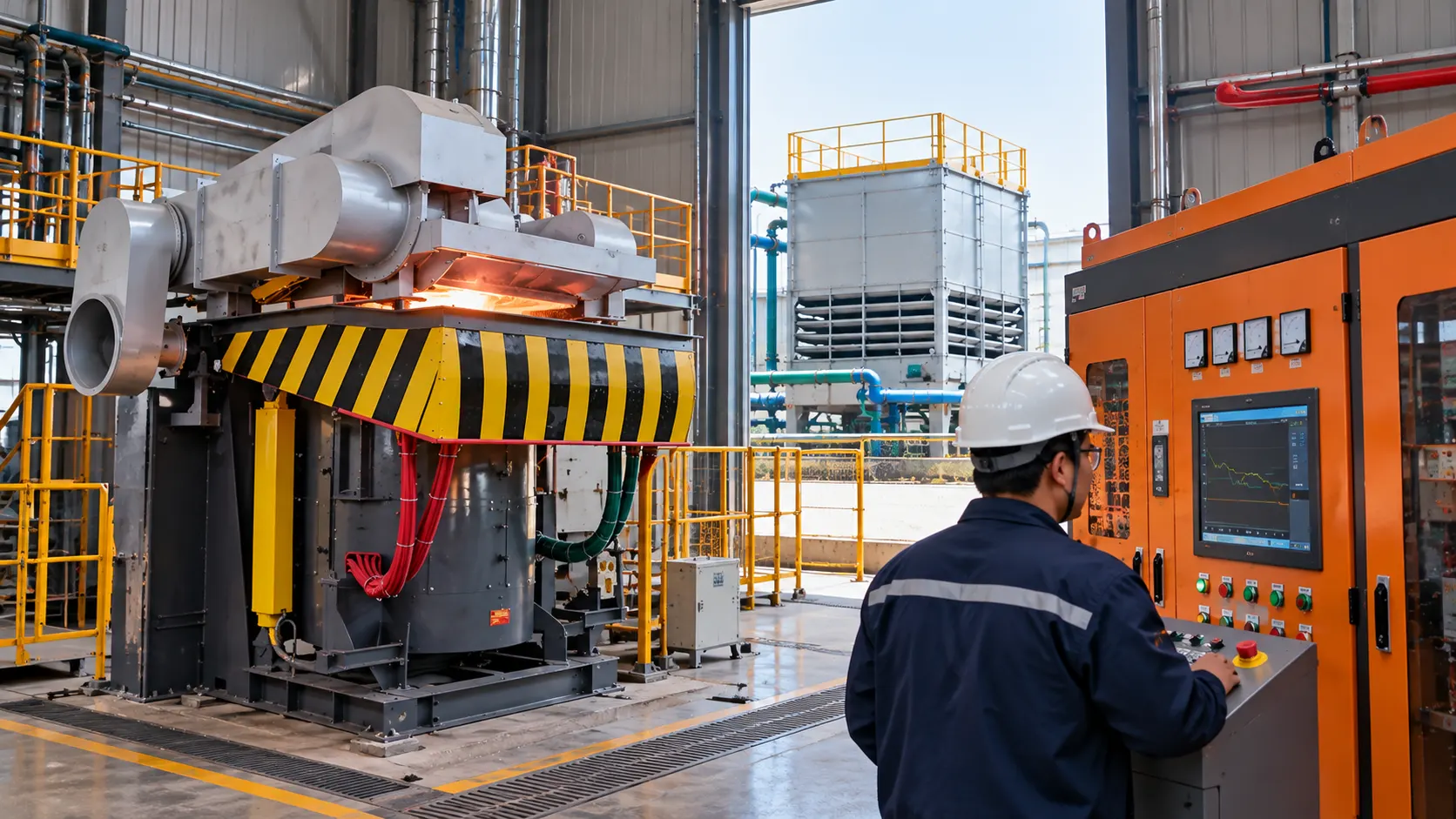
Induction furnace power falls when the electrical load changes or the system reaches a current, voltage, thermal, or protection limit. A brief change can be normal as scrap collapses into a liquid bath. A persistent or sudden loss of kilowatts can indicate poor matching, charge bridging, weak incoming power, restricted cooling, lining or coil changes, or a failing component. Diagnose it by correlating the melt stage with voltage, current, frequency, alarms, cooling data, and charge condition.
Power is not always flat from the first charge to tapping. The effective resistance and inductance of the furnace load change as cold scrap warms, loses magnetic behavior, settles closer to the coil, and forms a continuous molten pool. The resonant circuit must follow that changing load. Some systems begin at reduced power and rise after current and matching stabilize; power may also be intentionally reduced after full melting or during superheating and holding.
Treat the event as abnormal when the furnace cannot recover, the drop repeats at the same stage, an electrical limit is reached early, or an alarm, hot connection, cooling warning, unusual noise, or slower melt accompanies it. Compare like-for-like heats; one displayed number without context can mislead.
The coil, charge, lining, and capacitor bank form a coupled system. As scrap moves and bath geometry changes, impedance and resonant frequency shift. If the control cannot maintain the match, the cabinet may reach an intermediate-frequency current or voltage limit before rated active power. In parallel-resonant systems, capacitance and power-factor control also affect transfer. Adjustment is design-specific; follow the supplier's procedure rather than switching capacitors by trial and error.
Long, light, or badly mixed scrap can bridge above the melting zone. Lower material melts while the upper charge stops descending, destabilizing coupling and increasing local overheating risk. Excessive rust and contamination also reduce productive melting. Use approved charge dimensions and loading practice, and correct a bridge only under the plant's safe procedure. SHENNAI's melting-operation guidance also notes the relationship between charging condition, load stability, and power control.
Low or unbalanced voltage, transformer limitations, phase loss, weak connections, blown fuses, or rectifier problems can restrict DC-bus power. Trend three-phase input voltage and current under load. If input remains healthy while intermediate-frequency output falls, move downstream. If both fall, start with the utility, switchgear, transformer, rectifier, and connections. Qualified personnel must make these measurements.
Continuous cooling protects semiconductors, reactors, capacitors, cables, and the coil. Low flow, high temperature, blocked strainers, scale, air, reversed flow, pump problems, or faulty sensors can trigger derating or a trip. Check each protected branch—not only the pump gauge—and compare flow, pressure, temperatures, leakage status, and interlock history with approved limits. Never bypass a cooling alarm.
A weakened capacitor section changes resonance. SCR or IGBT faults, driver problems, reactor damage, failed sensors, undersized conductors, loose busbars, and damaged water-cooled cables can reduce power or cause repeated protection. A module alarm does not prove the module alone caused the event. Review SHENNAI's IGBT module failure guide before replacing parts or attempting a restart.
A new or overly thick lining, erosion, cracks, metal penetration, coil movement, insulation damage, or altered coil-to-charge distance can change coupling. Gradual problems may first appear as longer melt times. Compare trends with a known-good heat and inspect only at a safe, approved condition. Suspected metal penetration or a water hazard requires immediate emergency escalation.
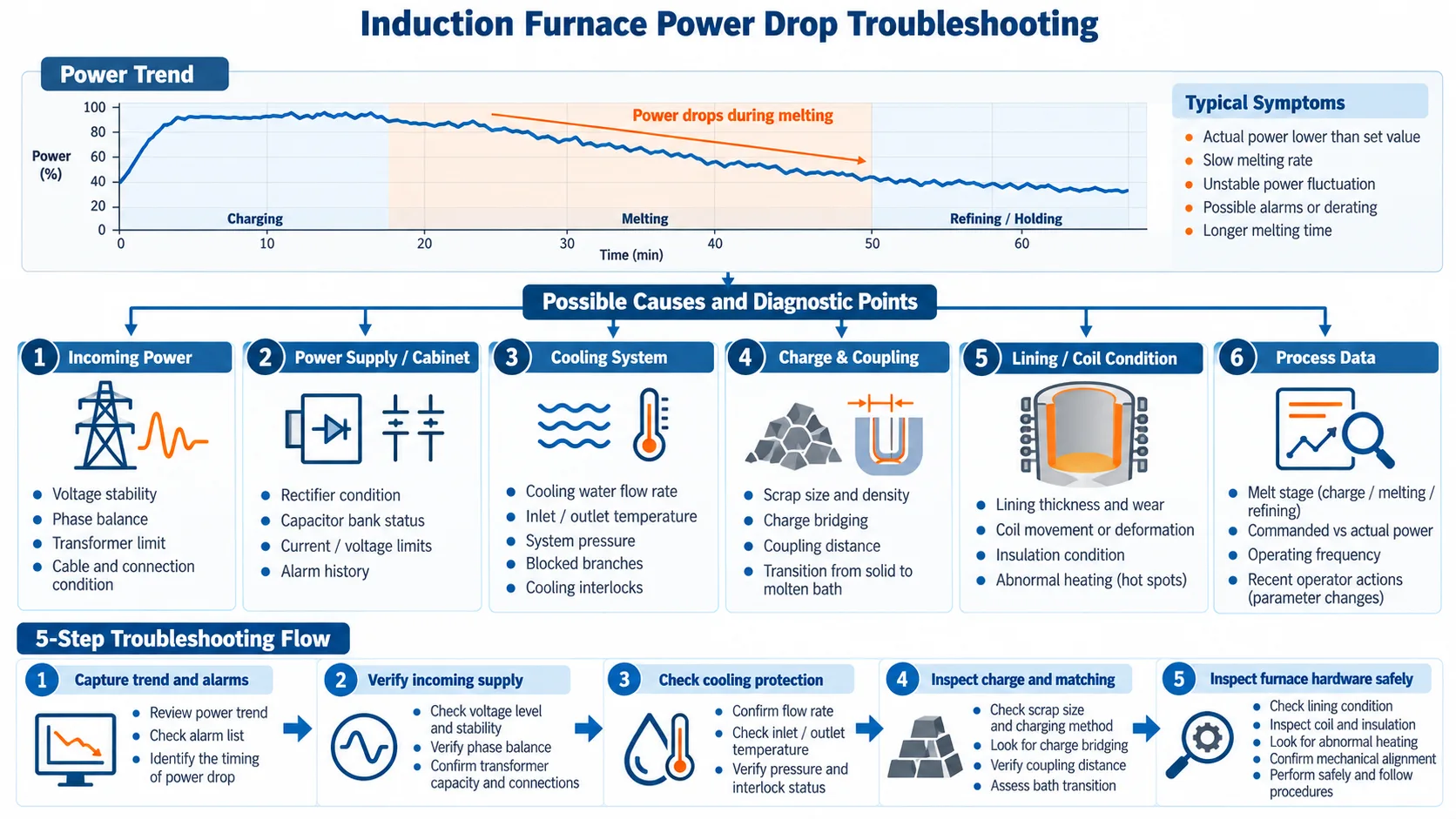
Do not begin by resetting alarms or changing several settings. Preserve the evidence and isolate the problem from supply to load. Exact test points and limits must come from the supplier's drawings and procedures.
If commanded power is high but actual power is low while an intermediate-frequency current or voltage limit is already reached, load matching, resonance, capacitor condition, coupling, or lining geometry deserves attention. If input voltage collapses or phase currents become unbalanced, investigate the upstream supply. If power falls after water temperature rises or flow declines, resolve the cooling cause and verify the interlock. If the drop follows scrap collapse without alarms and then recovers, the event may be a normal load transition. If the same heat stage now takes progressively longer than the historical baseline, inspect gradual changes such as connections, capacitors, conductors, lining thickness, or coil condition.
The medium-frequency power supply is only one part of the system. A sound diagnosis correlates cabinet data with the furnace body, capacitor bank, cooling circuits, transformer, charge, and operating practice. This prevents a maintenance team from replacing an expensive electronic component when the actual cause is a restricted water branch or unstable charge.
For remote support, send furnace and cabinet nameplates, metal and charge mix, capacity, rated power, input voltage, transformer data, lining age and thickness, cooling readings, alarm codes, melt stage, and time-stamped trends. Add clear photographs of the cabinet, capacitor bank, cable and coil connections, cooling manifold, and any damaged area.
State what changed before the problem: scrap, repaired cables, capacitor replacement, lining rebuild, transformer work, cooling maintenance, settings, or an unusual trip. An intermittent alarm may be the strongest root-cause clue.
Build a baseline for each repeatable melt recipe. Record electrical and cooling trends at cold start, early melting, scrap collapse, full bath, and superheating. Standardize scrap size and loading, maintain water quality and strainers, inspect connections and cables, track capacitor condition, and log lining campaigns. Match these practices to the exact induction melting furnace configuration because acceptable limits and control behavior differ by topology, furnace size, and metal.
Induction furnace power drops because the load, power circuit, cooling system, or protection state has changed. The key is to distinguish a normal melting-stage transition from a persistent loss of power. Capture the event, find the first limiting value, inspect supply and cooling, verify the charge and lining, and then check the electrical path under safe isolation. Avoid repeated resets and unapproved setting changes. For a configuration-specific review, send SHENNAI the trend data, alarms, cooling readings, charge details, and equipment nameplates through the project inquiry channel.
A temporary change can be normal because coupling, impedance, and resonance change as scrap collapses and a continuous bath forms. It should follow the expected control behavior and recover or transition as the approved operating recipe predicts.
The system may be reaching a current limit before achieving rated active power. Possible causes include load mismatch, capacitor or resonant-circuit condition, weak coupling, charge geometry, or lining changes. Compare current with voltage, frequency, power factor, and the supplier's approved limits.
No. If the cause is unknown, repeated resets can hide evidence or expose the system to another trip. Record the first alarm and operating conditions, inspect the relevant electrical, cooling, and furnace-side causes, and restart only under the approved procedure.
First preserve the alarm history and trend data. Then check whether the reduction was commanded, whether incoming power is stable, which electrical limit was reached, whether cooling remained within limits, and whether the charge bridged or changed position.
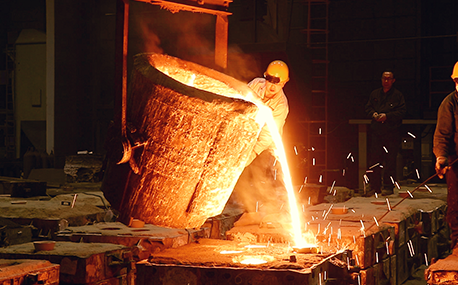
In the forging workshop, industrial furnaces smelt metals, including cupola, induction furnace, resistance furnace, electric arc furnace, vacuum furnace, open hearth furnace, crucible furnace, etc; There are sand mold drying furnace for baking sand mold, ferroalloy drying furnace and casting annealing furnace, etc; In the forging workshop, there are various heating furnaces for heating ingots or billets before forging and heat treatment furnaces for relieving stress after forging;
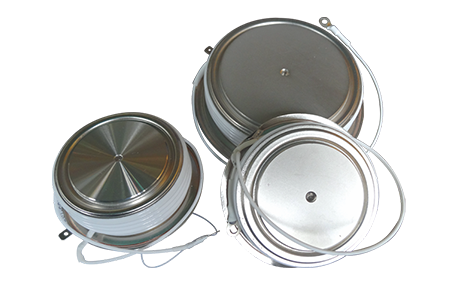
The most effective way for the failure of the medium frequency furnace is to use the low current experiment to judge whether it is the fault of the rectifier circuit or the fault of the inverter part. In the low current experiment, when the DC voltage is less than 513v, it indicates that there is a phase loss fault in the DC rectifier part. Check the specific thyristor fault, and the pulse breaking method should be used to judge whether it is the thyristor fault or there is no trigger pulse.
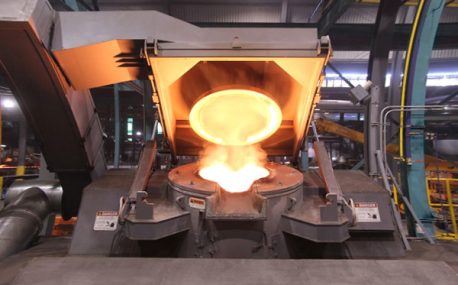
The most effective method for the failure of the intermediate frequency furnace is to use a small current experiment to judge whether the rectifier circuit is faulty or part of the inverter fault. When the DC current is less than 513 volts

Please send us your request and we will reply to you within 24 hours.
We will get in touch with you as soon as possible
