- Tel:+8616638907067
- Email:[email protected]
A solar powered induction furnace is technically feasible, but an industrial furnace usually cannot operate reliably from photovoltaic panels alone. Induction melting creates a high, variable electrical load, while solar output changes with the time of day, weather, season, and array conditions. The gap must be covered by battery storage, the utility grid, another dispatchable excerpt …
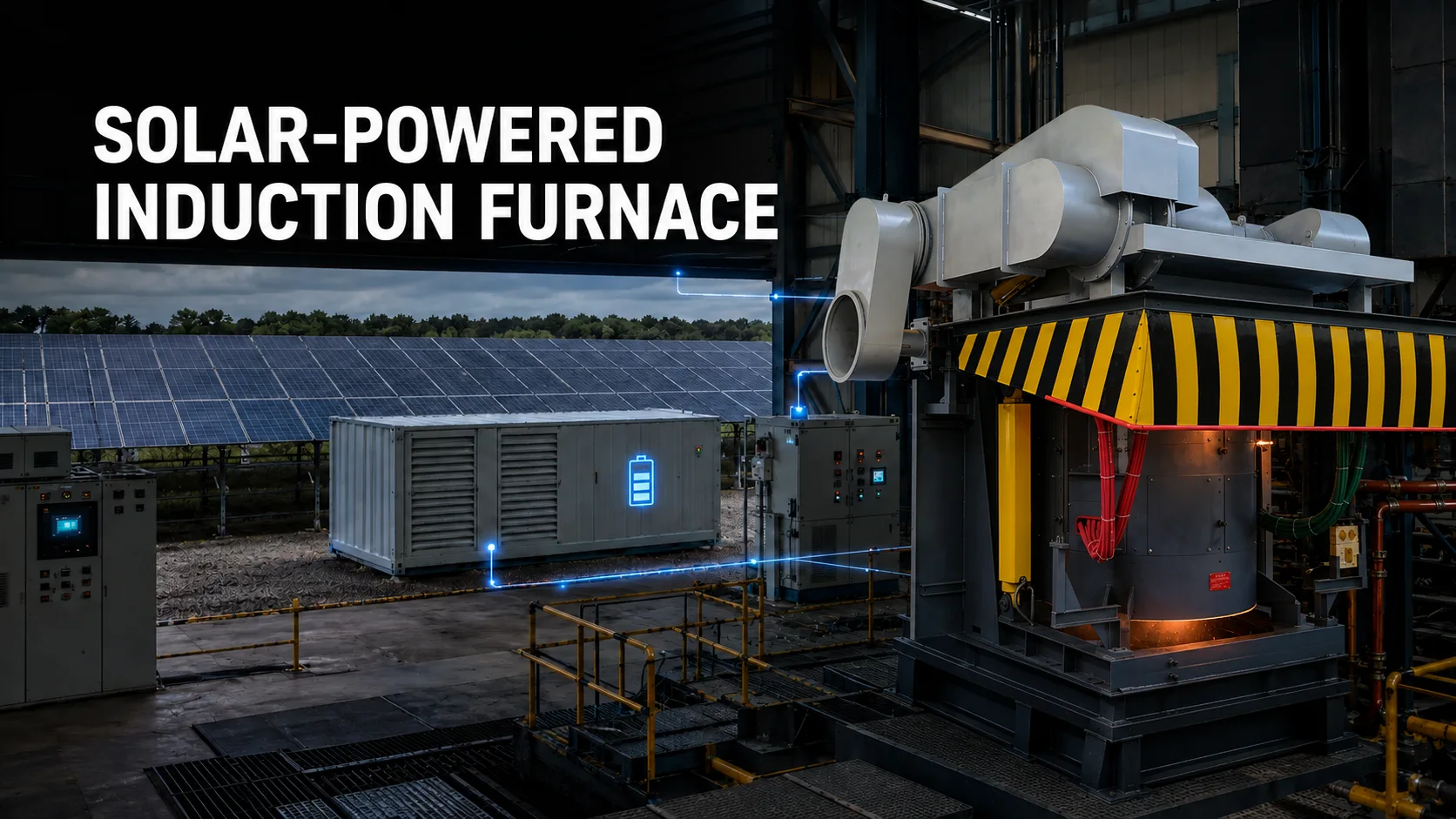
A solar powered induction furnace is technically feasible, but an industrial furnace usually cannot operate reliably from photovoltaic panels alone. Induction melting creates a high, variable electrical load, while solar output changes with the time of day, weather, season, and array conditions. The gap must be covered by battery storage, the utility grid, another dispatchable power source, or a combination of them.
For most foundries, the practical solution is a grid-connected solar microgrid with battery storage. The grid provides firm capacity, photovoltaic generation offsets part of the daytime load, and the battery can limit peaks, shift solar energy, or support defined loads during an outage. Fully off-grid induction melting is possible only under properly configured conditions and requires more than installing a large battery.
Furnace capacity does not provide enough information to size a renewable-energy system. A statement such as “one-ton induction furnace” describes the amount of metal the furnace can hold, but not the complete electrical profile of a heat.
A feasibility study must evaluate both power and energy:
Power, measured in kW or MW, determines whether the system can carry the load at a particular moment.
Energy, measured in kWh or MWh, determines how long the system can support that load.
The National Laboratory of the Rockies makes the same distinction in its REopt planning guidance. It defines electrical load as the power required at a given moment and electrical consumption as load multiplied by operating time. The REopt methodology uses location, utility tariffs, energy consumption, equipment efficiency, and dispatch conditions to evaluate solar and battery systems.
The battery inverter, transformer, switchgear, DC converters, and grid connection must be rated for the maximum coincident demand, not merely the average electricity use per ton.
An induction furnace does not necessarily draw exactly the same power throughout every heat. The operating condition changes during:
Cold-furnace startup
Initial coupling with a loose scrap charge
Furnace-charge collapse
Addition of new charge material
Formation of the molten bath
Slagging and temperature adjustment
Holding before pouring
Transfer between two furnaces
Simultaneous operation of multiple furnaces
Charge density, metal type, furnace lining condition, coil condition, and power-supply control can all influence the load profile. A production line with two furnaces may also create a much higher peak if both power supplies, cooling systems, hydraulic stations, and extraction systems operate simultaneously.
A battery can have enough stored energy but still fail to support the furnace if its converter cannot deliver the required MW output. Conversely, a high-power battery may support a short peak yet lack enough MWh capacity to finish a heat.
For an operating foundry, interval meter data are more useful than a monthly electricity bill. One-second or one-minute data can reveal peak demand, load ramps, holding periods, overlapping furnace operation, and the time available to recharge the battery.
Battery energy capacity should be calculated from the time-series deficit after available solar generation and permitted grid import have been deducted.
Consider a hypothetical scenario in which the furnace and auxiliaries require 2.5 MW, photovoltaic generation supplies 0.7 MW, and the project limits grid import to 1.0 MW. The battery must temporarily provide approximately 0.8 MW.
If that deficit continues for 90 minutes, its theoretical energy requirement is 1.2 MWh:
0.8 MW × 1.5 hours = 1.2 MWh
The installed battery would need more than 1.2 MWh of nominal capacity. Engineers must account for usable state-of-charge limits, inverter and transformer losses, battery temperature, degradation over the project life, operating reserve, auxiliary consumption, and the state of charge required before the next heat.
This is an example calculation, not a sizing recommendation. A real PV battery system for metal melting must use the plant’s measured or modeled load and generation profiles.
Stopping the melting power does not mean that every electrical load can be disconnected. Coil cooling, capacitor cooling, IGBT power-electronics cooling, controls, instrumentation, fume extraction, and other essential systems may need to continue operating during an interruption or controlled shutdown.
The feasibility study should divide the plant load into three categories:
Production loads: furnace power supplies and equipment required for normal melting.
Continuous auxiliary loads: cooling pumps, control systems, hydraulics, ventilation, and material-handling equipment.
Critical shutdown loads: equipment that must remain energized to protect personnel, the coil, the power supply, and the molten charge after melting power stops.
A battery designed only around furnace nameplate power can overlook these essential loads. The required backup duration should be based on an approved operating and shutdown procedure.
The correct architecture depends on the problem the foundry is trying to solve. Reducing annual grid consumption, limiting maximum demand, supporting a weak utility connection, and running completely off grid are different engineering objectives.
| Architecture | Role of solar and storage | Suitable conditions | Main limitations |
|---|---|---|---|
| Grid-connected solar | PV supplies part of the instantaneous plant load; the grid covers the balance | Reliable grid, daytime production, goal of reducing imported energy | Solar cannot normally maintain production during a grid outage without islanding capability |
| Grid-connected solar plus battery | Battery shifts solar energy, limits peaks, or supports selected loads | High demand charges, weak grid, time-of-use tariffs, or resilience requirements | Battery duty, power, duration, and dispatch strategy must be defined |
| Off-grid microgrid | PV, battery storage, and possibly a dispatchable source supply all plant loads | Remote site or inadequate grid, predictable production, sufficient renewable resource | Highest requirements for storage, reserve, protection, grid-forming control, and low-solar periods |
In a basic grid-connected configuration, photovoltaic power serves part of the foundry load while the grid supplies the remaining demand. The solar array does not have to equal the furnace’s full rated power.
This arrangement can suit foundries with reliable utility service and substantial daytime melting. It is generally simpler than designing an islandable microgrid, but the project must still review:
Transformer and switchgear capacity
Utility interconnection requirements
Reverse-power and export restrictions
Protection coordination
Harmonic and power-quality conditions
Demand charges and time-of-use tariffs
PV production when furnaces are idle
A large solar array may have limited economic value if most melting occurs after sunset or if excess midday power must be curtailed. Production scheduling can therefore be as important as installed PV capacity.
An induction furnace with battery storage can retain the grid as a firm source while assigning the battery a specific operational duty.
Possible duties include:
Capturing surplus midday solar energy
Reducing short furnace-demand peaks
Limiting grid import below a transformer or contracted-demand threshold
Charging during low-tariff periods and discharging during high-tariff periods
Supporting a weak grid during charge collapse or multi-furnace operation
Maintaining critical cooling and controls during an outage
Providing enough time for an orderly shutdown
These functions do not produce the same battery specification. Peak shaving may require high converter power but relatively short duration. Moving midday solar energy into an evening shift requires greater energy capacity. Outage support requires a defined critical-load list, reserve state of charge, islanding controls, and a restart plan.
A project should not request “one battery for all purposes” without prioritizing these duties. Holding reserve for an outage, for example, reduces the battery capacity available for tariff-based energy shifting.
A conventional grid-following PV inverter normally requires an established voltage and frequency reference. If the grid disappears, the inverter may disconnect for safety rather than continuing to energize the plant.
The U.S. Department of Energy describes a microgrid as loads and distributed energy resources operated together in either grid-connected or islanded mode. Its islanding example shows a PV array shutting down when utility power is lost and restarting only after another source energizes the microgrid.
An off-grid induction furnace therefore requires more than sufficient PV panels and battery capacity. The design must address:
Grid-forming voltage and frequency control
Black-start capability
DC and AC fault protection
Grounding and isolation
Load shedding
Restart sequence
Minimum battery reserve
Extended cloudy-weather operation
Safe shutdown if renewable energy remains insufficient
Where production interruptions are unacceptable, a dispatchable generator or retained utility connection may still be necessary. The appropriate decision depends on the cost of downtime, available solar resource, permitted backup fuels, and required operating hours.
Both AC- and DC-coupled architectures can support renewable energy induction melting. The choice affects retrofit complexity, conversion losses, control responsibility, protection, and future expansion.
In an AC-coupled retrofit, the PV inverter and battery power-conversion system connect to the plant’s AC distribution network. The existing induction furnace can remain connected through its transformer, switchgear, and medium-frequency power supply.
AC coupling may be appropriate when:
The furnace is already operating
Solar and storage will be installed in stages
The battery must also serve other plant loads
Equipment comes from different suppliers
Conventional grid operation must remain available
The EPC still needs to check transformer loading, inverter interaction, harmonics, protection settings, communications, and the maximum simultaneous output of the grid, battery, and PV system. Additional conversion stages may occur when PV energy is stored and later supplied to a furnace through AC-connected equipment.
A DC-coupled induction furnace power system coordinates PV, battery storage, and selected furnace-conversion stages through a common or linked DC bus. Depending on the design, this can avoid some unnecessary conversions between DC and AC.
However, a DC bus is not automatically more efficient or less expensive. The project must define:
DC voltage range
Galvanic isolation
DC fault interruption
Grounding method
Battery protection
Converter compatibility
Emergency isolation
Maintenance procedures
Responsibility for overall system control
DC coupling is more likely to be considered for a new foundry, a major electrical upgrade, a multi-furnace expansion, or a project designed around a solar microgrid from the beginning. AC coupling may remain the lower-risk option when the objective is to add renewable energy to an existing production line without redesigning its internal power architecture.
A credible sizing study needs synchronized production, electrical, solar, and tariff data. Annual electricity consumption alone cannot show whether renewable generation is available when the furnace needs it.
The load model should include:
Rated and actual furnace power
Cold-start and hot-start melt cycles
Power during charging, melting, temperature adjustment, and holding
Number of heats per shift
Time between heats
Single-, twin-, or multi-furnace operation
Cooling and auxiliary loads
Planned capacity expansion
Critical loads during an outage
For an existing plant, meter data should be matched with production records. This makes it possible to identify whether a peak came from cold melting, two furnaces overlapping, holding plus a new heat, or non-furnace equipment.
For a new plant, the supplier should provide an expected power-versus-time profile. A nameplate value shows an equipment limit, not how many MWh the production schedule will consume.
PV output depends on the site location, array orientation, temperature, shading, seasonal irradiance, and available roof or land. The same rated array will not produce the same hourly output at different sites.
The study should compare PV production and furnace demand at the same time intervals. Daytime melting may consume a high percentage of solar power directly. An evening or night shift requires storage, grid electricity, or another source.
Seasonal variation also matters. A system that supports the desired renewable fraction during a clear summer month may not deliver the same result during winter or a prolonged cloudy period. Off-grid studies must test unfavorable renewable conditions rather than relying only on annual-average production.
A preliminary power relationship is:
Required battery power ≈ Supported load − available PV − permitted grid import
A preliminary usable-energy relationship is:
Required usable battery energy ≈ Sum of time-series energy deficits during the required operating period
These relationships are starting points, not final design formulas. Final sizing must include conversion efficiency, usable depth of discharge, battery degradation, ambient temperature, reserve margin, discharge-rate limits, auxiliary consumption, and the time available for recharging.
The RFQ should state whether the battery must:
Support a five-minute peak
Limit grid import throughout a complete heat
move midday solar production into an evening shift
Maintain cooling during shutdown
Complete one or more heats during an outage
Support full off-grid operation for a defined number of hours
Without this operating definition, battery quotations with similar MW and MWh figures may deliver very different practical results.
A foundry renewable energy system is most attractive when the project solves a measurable electrical or production problem.
Strong conditions may include:
Significant melting during solar-generation hours
High maximum-demand charges
Large peak and off-peak electricity-price differences
A transformer or grid connection that constrains expansion
Frequent but relatively short grid disturbances
Adequate roof or land for PV
Measured load data and a predictable production schedule
Planned new furnaces or a major electrical upgrade
The investment case is weaker when most production occurs at night, solar area is limited, long outages must be covered without backup generation, or the electricity tariff provides little value for reducing peaks or shifting energy.
A feasibility study should compare solar and storage with other options, including transformer expansion, production rescheduling, solar without storage, targeted peak-shaving storage, a dispatchable backup source, and improved furnace power control.
The financial model should include battery replacement assumptions, degradation, cooling or HVAC, fire protection, inverter maintenance, insurance, financing, curtailment, and production losses if stored energy becomes unavailable. No fixed payback period can be inferred from furnace capacity alone.
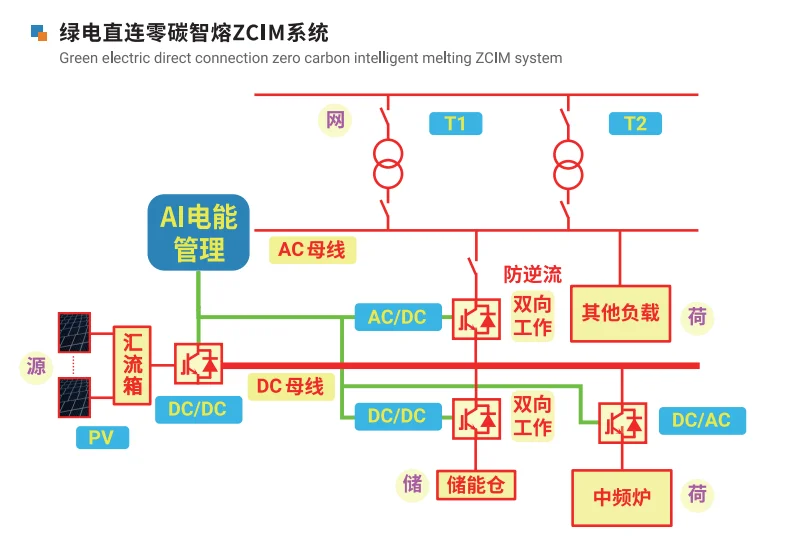
SHENNAI’s Zero Carbon Intelligent Melting, or ZCIM, is an energy-management architecture rather than a standalone furnace. Its documented layout coordinates photovoltaic generation, battery storage, the utility grid, AC and DC buses, induction-furnace loads, and other plant loads.
Depending on the selected configuration, AC/DC, DC/DC, and DC/AC conversion stages connect the energy sources and loads. A DC bus can route much of the system’s energy without requiring every transfer to pass through the AC bus. The potential reduction in conversion stages must still be verified for the actual project architecture.
The ZCIM control layer is designed to coordinate source availability, battery state of charge, grid import, peak-valley electricity prices, and furnace demand. This is particularly relevant when two or more furnaces could otherwise create overlapping demand peaks. The controller can manage energy distribution, but it cannot create power or energy that the installed PV, battery, and grid connection do not possess.
SHENNAI documentation describes complete off-grid operation under specific working conditions. This limitation must remain part of every proposal. The achievable operating mode depends on storage power and duration, PV production, grid-forming equipment, protective devices, auxiliary loads, metal production requirements, and reserve strategy. ZCIM should therefore be described as a renewable-energy-integrated melting architecture, not an unconditional zero-grid or zero-emissions guarantee.
Solar panels and batteries do not energize the induction coil directly. The energy must pass through a controlled power-conversion system that supplies the frequency, voltage, and current required by the resonant melting circuit.
In a series-resonant induction system, the furnace coil and compensation capacitor form the resonant load. Phase-shift and phase-lock control regulate inverter output as the charge condition changes. This matters during cold startup, charge collapse, bath formation, and lining changes because the electrical characteristics seen by the power supply do not remain constant throughout the heat.
According to SHENNAI technical data, typical documented full-bridge application bands include:
3–10-ton furnaces, 2,000–5,000 kW, 300–500 Hz, with a listed 5 kV maximum RMS coil voltage
10–30-ton furnaces, 8,000–20,000 kW, 100–300 Hz, with a listed 5 kV maximum RMS coil voltage
These figures are technical reference ranges for the documented configurations, not universal selection limits or project guarantees. The final power supply must be selected according to metal type, furnace capacity, target output, coil design, input voltage, transformer, cooling system, and operating method.
The full-bridge IGBT medium-frequency power supply is relevant to ZCIM because the furnace converter and energy-management system must exchange compatible power limits. If the battery controller tries to reduce grid import without recognizing the furnace’s current heat stage, it may impose an unrealistic power limit and extend melting time. Integrated control can instead coordinate the available grid, PV, and storage capacity with the actual furnace demand.
A steel shell induction furnace system still requires its own matched furnace body, coil, hydraulic tilting equipment, cooling system, refractory practice, transformer, and power cabinet. ZCIM coordinates the energy sources and loads; it does not replace the furnace or independently melt metal.
A useful RFQ should allow the furnace supplier, storage integrator, and EPC to model the same production scenario. Provide the following information:
Metal or alloy to be melted
Furnace capacity and target hourly output
Number of furnaces
Single-, twin-, or multi-furnace operating method
Existing power-supply type and rated power
Cold-start and hot-start melting times
Heats per shift and annual production hours
Holding-temperature and pouring requirements
Site voltage and frequency
Transformer rating and current loading
Utility grid-import or contracted-demand limit
Current electricity consumption per ton, if reliably measured
Interval load data, preferably matched to production records
Cooling-water flow, pressure, temperature, and essential shutdown loads
Existing or planned PV capacity
Hourly or sub-hourly PV-production model
Existing or proposed battery power and energy capacity
Battery chemistry and usable state-of-charge range
Battery purpose: peak shaving, tariff shifting, backup, weak-grid support, or off-grid operation
Required outage duration and acceptable production reduction
Peak, off-peak, energy, and maximum-demand tariffs
Ambient temperature, altitude, dust, space, and installation constraints
Applicable local grid, battery, fire, and electrical requirements
Future furnace, transformer, or production expansion
The supplier or EPC should return a single-line diagram, an hourly or sub-hourly energy balance, operating-mode descriptions, battery-duty assumptions, critical-load schedule, protection concept, and a list of conditions behind any performance projection.
For an off-grid proposal, request a documented black-start sequence and an explanation of what happens if PV output remains below forecast. The answer should state which loads are shed, whether melting can continue at reduced power, how long cooling remains available, and whether a dispatchable backup source is required.
An industrial induction furnace can run with solar power and battery storage, but a feasible project must match two different requirements: enough instantaneous power to carry the furnace and enough stored energy to support it for the required time.
For most foundries, a grid-connected hybrid architecture provides a more manageable starting point than complete off-grid operation. Solar can offset daytime consumption, while battery storage can limit demand peaks, move energy between tariff periods, support a weak grid, or maintain defined critical loads. Off-grid operation requires additional grid-forming, black-start, protection, reserve, and low-solar planning.
Luoyang Shennai Power Equipment Co., Ltd. can assess the full-bridge IGBT power supply and ZCIM energy architecture as parts of one melting and energy system. To request a ZCIM feasibility review, submit the furnace load, metal, production schedule, transformer data, measured electricity profile, tariff, planned PV capacity, battery objective, cooling requirements, and expected grid-connected or off-grid operating mode.
It may supply part or all of the instantaneous load under favorable conditions, but furnace tonnage alone is not enough to decide. The study must compare furnace power, auxiliary loads, usable roof area, local solar generation, inverter capacity, battery rating, and permitted grid import. Grid support is usually required when solar output falls below the furnace load.
Yes, if battery storage, the utility grid, or another dispatchable source supplies the required power and energy. The battery must be sized for the nighttime load duration, conversion losses, usable state of charge, reserve margin, auxiliary equipment, and the planned number of heats.
Yes, under properly engineered conditions. The system needs adequate PV and storage capacity, grid-forming control, black-start capability, coordinated protection, essential-load support, and a plan for prolonged low-solar conditions. Some projects may still require a dispatchable backup source.
Not automatically. Operational emissions depend on the timing and share of onsite renewable generation, grid electricity, backup generation, and storage losses. Corporate electricity claims also depend on the applicable Scope 2 accounting method and evidence for purchased renewable electricity.
Collect a time-based load profile covering the furnace, cooling system, auxiliaries, and simultaneous production equipment. Then define the battery’s duty and compare the load with site-specific PV generation and permitted grid import. Battery capacity should not be selected from furnace tonnage or monthly electricity consumption alone.
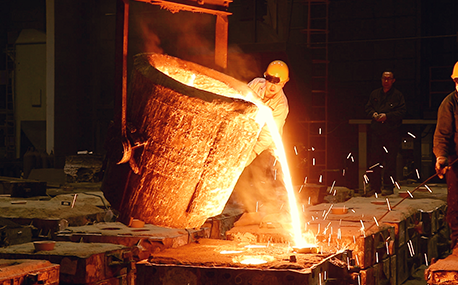
In the forging workshop, industrial furnaces smelt metals, including cupola, induction furnace, resistance furnace, electric arc furnace, vacuum furnace, open hearth furnace, crucible furnace, etc; There are sand mold drying furnace for baking sand mold, ferroalloy drying furnace and casting annealing furnace, etc; In the forging workshop, there are various heating furnaces for heating ingots or billets before forging and heat treatment furnaces for relieving stress after forging;
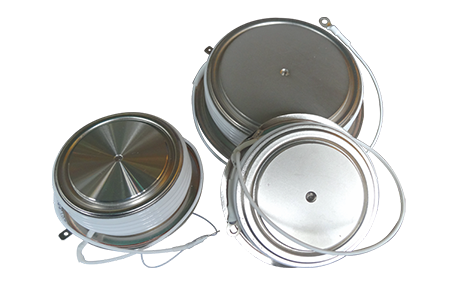
The most effective way for the failure of the medium frequency furnace is to use the low current experiment to judge whether it is the fault of the rectifier circuit or the fault of the inverter part. In the low current experiment, when the DC voltage is less than 513v, it indicates that there is a phase loss fault in the DC rectifier part. Check the specific thyristor fault, and the pulse breaking method should be used to judge whether it is the thyristor fault or there is no trigger pulse.
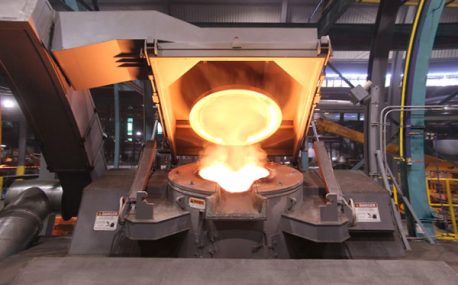
The most effective method for the failure of the intermediate frequency furnace is to use a small current experiment to judge whether the rectifier circuit is faulty or part of the inverter fault. When the DC current is less than 513 volts

Please send us your request and we will reply to you within 24 hours.
We will get in touch with you as soon as possible
